Monday, August 24, we will meet in person.
Go to calendar for our schedule
Address for OHMC meditation space:
3812 Northampton St. NW, Washington DC 20015
Please arrive a few minutes early so we can invite the bell on time. You may also arrive 15 minutes early to practice working meditation by helping us set up cushions.
Dear Friends,
This week, we will meet Monday evening, August 24, from 7-8:30PM ET in person at our meditation space (3812 Northampton Street NW); Wednesday morning, August 26, from 7-8AM ET online; and Friday, August 28, 12-1PM ET online/in person.
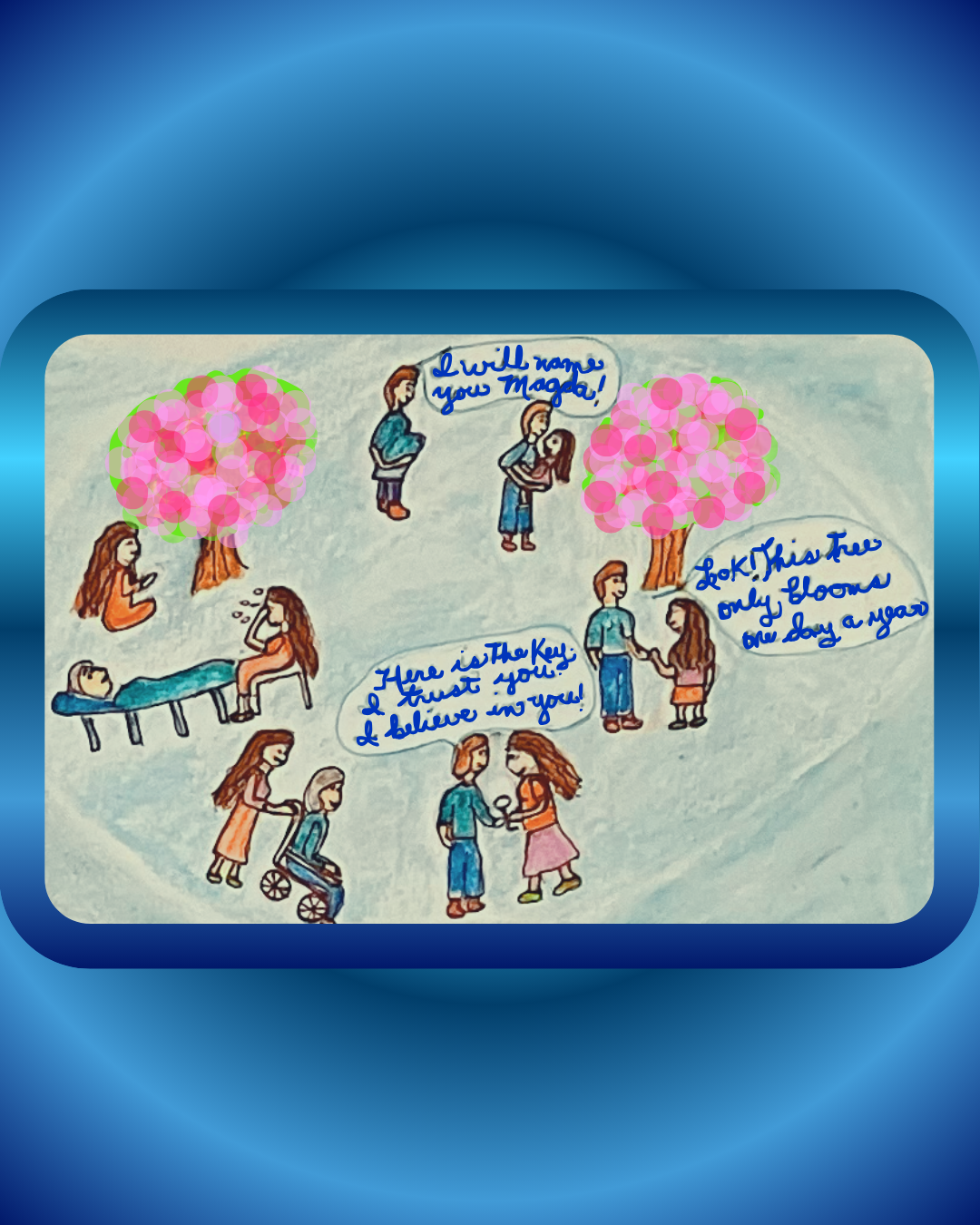
On Monday, our evening meditation will be facilitated by Magda. We will continue our Monday evening summer reading of Thich Nhat Hanh’s At Home in the World. Our discussion will focus on the chapter called “I Have Arrived” with special emphasis on “Look into your Hand” (p. 156-7), “Walking on Country Paths” (p. 166), and “I am Not in Here” (p. 180). Read on for Magda’s reflections on this story.
“You are there for me and I am here for you — this is the teaching of interbeing.” — At Home in the World, p. 88
I am sitting where I always write when I am in Puerto Rico. Through breathing, I have slowly learned how to truly live here — within a different kind of connection: fluid, aware, and moving like the ocean surrounding the island.
My room remains unchanged, filled with the clothes, jewelry, and the belongings I have kept here over the past six years. The wind still rushes through the balcony doors into my open corner room. At night, the wind chimes sing accompanied by the coquí frogs, and somewhere nearby there is always music.
Everything is the same except for one essential thing:
My mother no longer lives here.
A few months ago, she fell and fractured her pelvis. Now she lives in an assisted living facility, and once again I have returned to be near her.
As I sit on the deck in meditation, I feel sadness mixed with acceptance—the quiet emptiness left by someone who has been part of my life since I entered this world.
I begin breathing in and out.
Slowly, I begin to dwell in what Thầy called the ultimate dimension. In that dimension, my mother is still here and will always remain here.
I see her in the hangings on the walls, in my grandmother’s artwork, in the chair where she watched television, and in the balcony seat where she admired the trees, parrots, and parakeets. She is here.
Thầy once wrote that he looked at his hand to see his mother. I look at my own hand, and my mother is here too.
I remember her laughing on New Year’s Eve while infinite fireworks exploded across the island, saying, “We may as well stay awake until midnight because the fireworks won’t stop before then.” I did not know then that I was witnessing one of the last times I would see her standing with ease. Today, even walking has become difficult for her.
The traces of her physical presence are slowly disappearing from this home. The breeze no longer carries her voice.
So I return to my breathing. And here, in the ultimate dimension, my mother continues.
As I sit beside her empty chair, I notice the tree that flowers only one day each year. She always called me on the day it bloomed. That day was always special to us. Today, the tree is in full bloom once again.
I think of my mother and her love of trees.
Softly, I whisper to my mother within me:
“You are there for me and I am here for you — this is the teaching of interbeing.”
WALKING WITH MY MOTHER
In At Home in the World, Thầy writes: “There is no beginning and no end. I will never die. There will be a dissolution of this body, but that does not mean my death. I will continue, always.”
This is how I feel about my mother, my grandmother, and my father.
When I walk or paint, I feel my ancestors beside me. In Walking on Earth, Thầy reminds us that we never walk alone. Our parents and ancestors are present in every cell of our bodies, and each mindful step transforms not only ourselves, but all those who came before us.
Through the ultimate dimension, I understand that just as my father continues within me nearly fifty years after his passing, my grandmother also continues—especially when I paint.
Thầy once wrote that when he practiced calligraphy, he invited his mother, father, and teacher to draw with him. Together, they touched the insight of no-self.
When my mother eventually leaves this physical form, I will continue doing what I already do with my father, grandmother, and Thầy:
I will walk with my mother when her body no longer can.
As her body has become more fragile, I have reflected on this often. Just as I now see my mother in my hand, one day I will walk with her through my own feet.
Preparing to walk, breathing in and out, I whisper softly:
“You are there for me and I am here for you.”
She will continue in the stream of life—with my father, my grandmother, Thầy, my sons and those who will continue through them.