Monday, August 17, we will meet online.
Dear Friends,
This week, we will meet Monday evening, August 17, from 7-8:30PM ET online; Wednesday morning, August 19, from 7-8AM ET in person at our meditation space (3812 Northampton Street NW); and Friday, August 21, 12-1PM ET online.
On Monday, our evening meditation will be facilitated by Magda. We will continue our Monday evening summer reading of Thich Nhat Hanh’s At Home in the World. Our discussion will focus on the chapter called “At Home in the World,” with special emphasis on “Greeting Each Other” (p. 130) , “The Footsteps of the Buddha” (p. 138-9), and “Olive Trees” (p. 148). Read on for Magda’s reflections on this story.
While reading At Home in the World, I realized how often I feel at home in places far from where I was born. Since leaving Puerto Rico at nineteen, I have lived in different parts of the United States and traveled widely, guided by spiritual longing and the promise of pilgrimage.
As a Venezuelan–Puerto Rican woman, I have never had a single place I could call my original home. Venezuela first became home through the stories of my grandmother, who spoke of it with such tenderness that I inherited her love for it. Later, the United States became another kind of home through friendships, community, and my children.
Over time, I discovered that certain places awaken in me a deep feeling of recognition, as though I have walked there before. I first experienced this in Old Town Albuquerque, where I felt an inexplicable familiarity, a sense of touching something timeless.
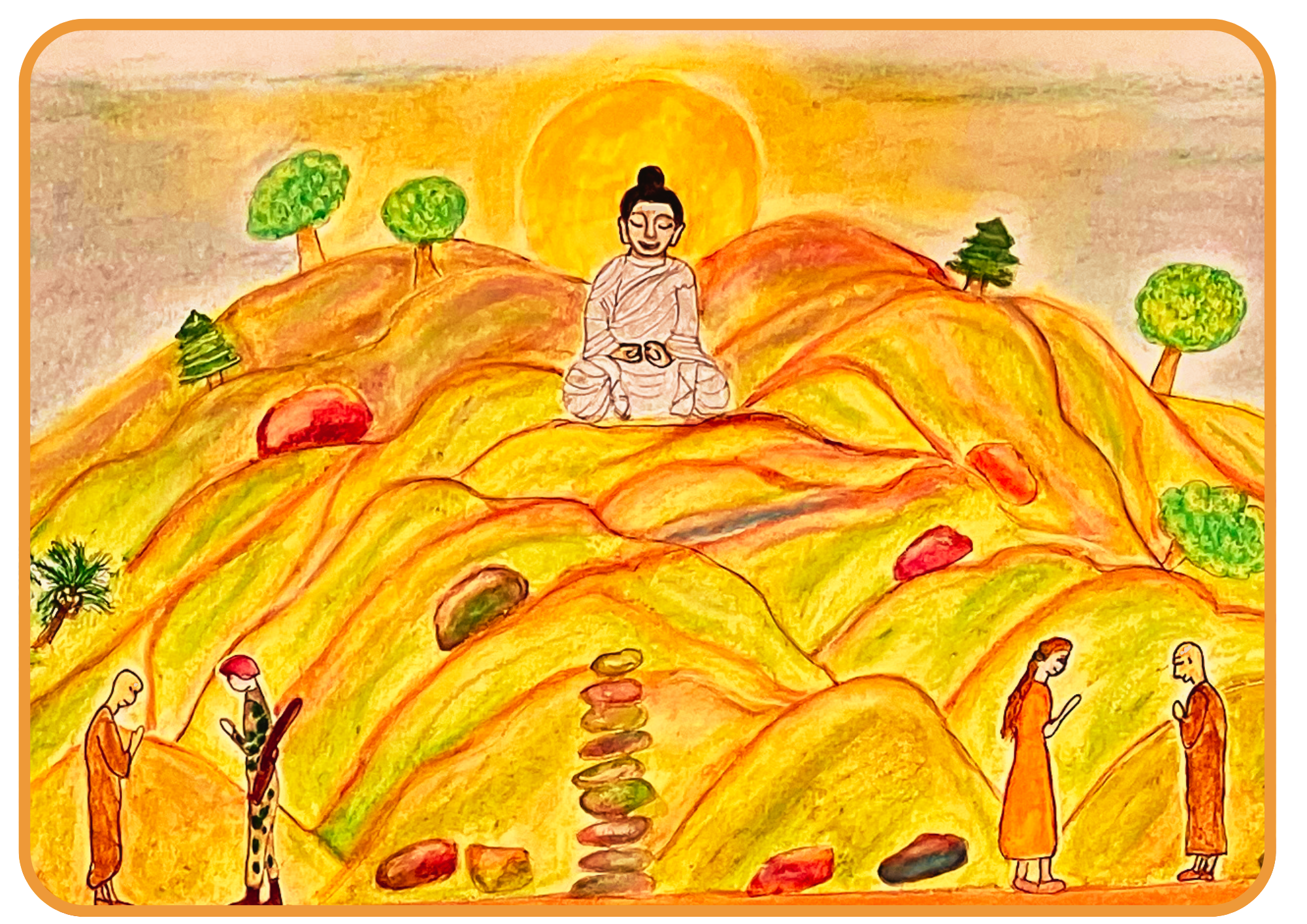
Walking meditation has become essential to this experience of belonging. Whether beneath the orange gates of Fushimi Inari Taisha, among the poplars at Plum Village, along the beaches of Puerto Rico, or at Từ Hiếu Temple in Vietnam during Thầy’s Ashes Ceremony, the same words arise within me:
“I have arrived. I am home.”
Breathing mindfully transforms these places into sacred spaces where I experience interbeing with the land, the ancestors, and the people around me.
I have also learned that home is often found in simple places: a quiet café in Paderborn, a humble cafe in Rome, or even the cafeteria of a hospital in Puerto Rico while visiting my mother. Like Hemingway’s “A Clean, Well-Lighted Place,” these spaces offer warmth, refuge, and quiet healing.
Wherever I travel, I search for places where I can read, write, reflect, and envision my next painting. Often, I hear familiar music or encounter familiar gestures that dissolve the feeling of separation between cultures and countries.
I feel especially at home among spiritual friends I have met through the Plum Village tradition and other pilgrimages. These friendships remind me that home can also exist in human connection. Through shared meals, dancing, silence, and deep listening, I experience a collective energy of openness and care.
Sometimes, a smile alone creates this feeling. I remember meeting a roommate at a retreat in the Netherlands whose warmth allowed me to reveal vulnerabilities I had never shared before. I remember embracing Sister Hoa Lam from Plum Village and feeling immediately at home in her presence. As Thầy taught, perhaps our first exchange of energy happens through a smile.
This understanding deepened as I reflected on Thầy’s writings about the interconnection and continuity nourished by olive trees. Ancient olive trees, though hollowed, wounded, and twisted by time, continue to live and bear fruit. What may appear on the surface to be three or four separate trees may, in fact, arise from the same root.
Even after trees fall, they nourish new life through decay, becoming shelter, soil, and sustenance for future growth. In forest ecology, fallen trees become “nurse logs,” supporting entire ecosystems. What appears to be death becomes another form of continuation.
These trees remind me of our ancestors and of interbeing itself. Nothing truly disappears. Life transforms, nourishes, and continues in other forms.
Perhaps this is why so many places in the world feel like home to me. Beneath our differences, we are all connected. We share common ancestors and belong to the same living web.
And perhaps the truest home is not a country or a house, but the quiet awareness that we already belong—to the living world and to one another.