
Monday, August 10, we will meet in person.
Go to calendar for our schedule
Address for OHMC meditation space:
3812 Northampton St. NW, Washington DC 20015
Please arrive a few minutes early so we can invite the bell on time. You may also arrive 15 minutes early to practice working meditation by helping us set up cushions.
Dear Friends,
This week, we will meet Monday evening, August 10, from 7-8:30PM ET in person at our meditation space (3812 Northampton Street NW); Wednesday morning, August 12, from 7-8AM ET online; and Friday, August 14, 12-1PM ET online/in person.
This week, Annie will guide our meditation. Annie shares:
This week we continue our reading of Thich Nhat Hanh’s book At Home in the World. We have been reading the chapter “The Blossoming of Plum Village,” from the section “Brother and Sister” through the end of the chapter. If you haven’t read the book, please join us on Monday anyway, as we will read one section of the book together; you won’t have missed anything.
One of the sections from this week’s reading is called “Tangerine Meditation.” In it, Thich Nhat Hanh (Thay) writes about what it means to really eat a tangerine. He describes a practice of generating insight into the Interbeingness of the tangerine and how looking deeply like this can lead to greater happiness.
He noticed that his friend was eating while thinking and talking. (I’m guessing most of us have done this quite often.) He instructs his friend on how to use the time of eating to generate more happiness.
He writes:
During the time you eat a tangerine, eating the tangerine is the most important thing in your life…
The next time you’re at work or school and you have a snack like a tangerine, please put it in the palm of your hand and look at it in a way that makes the tangerine real. You don’t need a lot of time to do this, just two or three seconds.
Looking at it, you can see a beautiful tree, a blossom, the sunshine, and the rain, and you can see a tiny fruit forming. You can see the continuation of the sunshine and the rain, and the transformation of the baby fruit into the fully developed tangerine in your hand. You can see the color changing from green to orange, and you can see the tangerine ripening and sweetening. Looking at a tangerine in this way, you will see that everything in the cosmos is in it—the sunshine, rain, clouds, trees, leaves, everything. Peeling the tangerine, smelling it, and tasting it, you can be very happy.
In 2019, Sister Chan Duc (a senior dharma teacher at Plum Village and the first Western European woman to be ordained as a nun by Thay in 1988) spoke about mindful eating. She said:
When I sit and eat a meal, I am aware of my brothers and sisters who are eating with me, and I know they also are children of the Earth. If I cannot understand them and love them, then I cannot understand and love the Earth. A mealtime includes being grateful for the food, feeling love for Mother Earth and the universe that has produced the food, and feeling grateful for our brothers and sisters who are with us, and feeling love for them.
We can use any time we are eating to practice developing our Bodhicitta, our Mind of Love. This Mind of Love may be defined as the willingness to practice, to wake up and serve others. To do this, we look at the food we are eating and cultivate gratitude for the Earth, who is the source of all food, the food itself, all the beings who made the food possible, our sangha, and all of our beloved friends and family. Instead of eating in an unconscious way, eating with the Mind of Love can bring us a lot of joy and provide us with the energy we need for taking care of the world together.
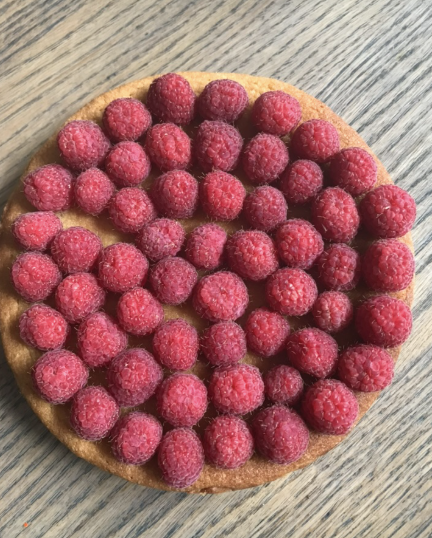
On Monday, we will read together the section from Thay’s book and a short excerpt from Sister Chan Duc’s talk (section and excerpt below), and then we will enjoy cultivating siblinghood and the Mind of Love while eating some summer fruits together in silence.
I hope to see you then!
warmly
annie.
Sister Chan Duc, excerpt from 2019 talk:
Mindful Eating
We want to wake up to the fact that we are connected with everything on the Earth. And what better opportunity than when you are eating a meal, eating in mindfulness, relating to the food that you are eating.
When I was in my early twenties, I suffered from something called anorexia nervosa. This means that I didn’t eat. I didn’t want to eat anything. It was very damaging for my body and also damaging for my mind. It planted seeds in my body and my mind, which harmed me. Now I realize I was also harming Mother Earth, as well as my genetic mother and father who worried about me. But at the time I was not aware of what I was doing. I did not have the bodhicitta, the mind that was awake. I was not the waking-up bodhisattva. It took me some time to realize what I was doing. Eating in mindfulness restored my right relationship with what I am eating. I am very grateful for the practice of mindful eating.
When I put a spoonful of millet in my mouth, I feel closely connected to the whole universe. I feel connected to the sun, to the stars, to the earth under my feet and to the atmosphere around me, which contains the clouds and the rain. I feel all these things coming together to nourish me. My heart is filled with gratitude, and I know that as a child of the Earth, I’m being nourished by the Earth. As I eat in mindfulness, I’m also aware of where the food comes from. I have to be aware of how far away the food has come from and how the food was transported to me. There is still some carbon footprint in what I eat, but that does not take away my joy of eating. Although I want to minimize the carbon footprint of what I eat, at the same time I know the most important thing is my relationship to Mother Earth, the atmosphere. When I feel that deep gratitude in me, and that deep aspiration to take care of the Earth as I take care of myself, I know that I am doing the very best I can.
Bodhicitta means literally the mind of awakening, but Thay has translated this as the mind of love, as if awakening and love are not two separate things.
When I sit and eat a meal, I am aware of my brothers and sisters who are eating with me, and I know they also are children of the Earth. If I cannot understand them and love them, then I cannot understand and love the Earth. A mealtime includes being grateful for the food, feeling love for Mother Earth and the universe that has produced the food, and feeling grateful for our brothers and sisters who are with us, and feeling love for them.
During the day, I keep alive my awareness of Mother Earth with my mindfulness and with the use of the gathas. When I wash my hands, I intend that all may have hands blessed to save this planet Earth. When I wash my hands, I want to be a hundred percent in touch with the water. Water is such a precious gift of the earth and the sky. We know that sources of clean water in the Earth are drying up, the aquifers are drying up—those underground rivers that used to be there are no longer there. Clean water is a precious, precious gift. I want to do my best not to waste it, even though it’s difficult sometimes to adjust the tap so that too much water doesn’t come out. It is a joy for me to be able to adjust it so that just the amount of water I need comes out. And I can catch that water in a bowl—I don’t have to let it keep flowing—and then I can take the water from the bowl and wash my face.
It doesn’t take an effort to do that. I don’t have to force myself to do this. I am the Earth, and the Earth is me. When I take care of the Earth, when I take care of the water, I’m taking care of me.
Tangerine Meditation, excerpt from At Home in the World:
Many years ago, I met a young American named Jim who asked me to teach him about the practice of mindfulness. One time when we were together, I offered him a tangerine. Jim accepted the tangerine, but he continued talking about the many projects he was involved in—his work for peace, social justice, and so on. He was eating, but at the same time he was thinking and talking. I was there with him as he peeled the tangerine and tossed the sections of it into his mouth, quickly chewing and swallowing.
Finally I said to him, “Jim, stop!” He looked at me, and I said, “Eat your tangerine.” He understood. So he stopped talking, and he began to eat much more slowly and mindfully. He separated each of the remaining sections of the tangerine carefully, smelled their beautiful fragrance, put one section at a time into his mouth, and felt the juices surrounding his tongue. Tasting and eating the tangerine this way took several minutes, but he knew there was no reason to hurry, and that he had enough time to enjoy eating the tangerine. Eating this way, he knew that the tangerine had become real, the one eating the tangerine had become real, and life had also become real in that moment. What is the purpose of eating a tangerine? It is just for eating the tangerine. During the time you eat a tangerine, eating the tangerine is the most important thing in your life.
The next time you’re at work or school and you have a snack like a tangerine, please put it in the palm of your hand and look at it in a way that makes the tangerine real. You don’t need a lot of time to do this, just two or three seconds. Looking at it, you can see a beautiful tree, a blossom, the sunshine, and the rain, and you can see a tiny fruit forming. You can see the continuation of the sunshine and the rain, and the transformation of the baby fruit into the fully developed tangerine in your hand. You can see the color changing from green to orange, and you can see the tangerine ripening and sweetening. Looking at a tangerine in this way, you will see that everything in the cosmos is in it—the sunshine, rain, clouds, trees, leaves, everything. Peeling the tangerine, smelling it, and tasting it, you can be very happy.