
Monday, April 13, we will meet online.
Dear friends,
This week, we will meet Monday evening, April 13, from 7-8:30PM ET online; Wednesday morning, April 15, from 7-8AM ET in person at our meditation space (3812 Northampton Street NW); and Friday, April 17, 12-1PM ET online.
On Monday night, Christopher and Sunil from Wake Up DC will facilitate alongside Magda. The Engaged Mindfulness Circle has invited them as a continuation of the Cartas de Paz Project with Casa de Paz Colorado—a letter-writing initiative to support individuals detained by ICE that began on April 4 and will continue on May 2. Christopher and Sunil will guide a session exploring the role of Wake Up DC through a lens of compassion and interbeing, inspired by Thich Nhat Hanh’s teachings and legacy.
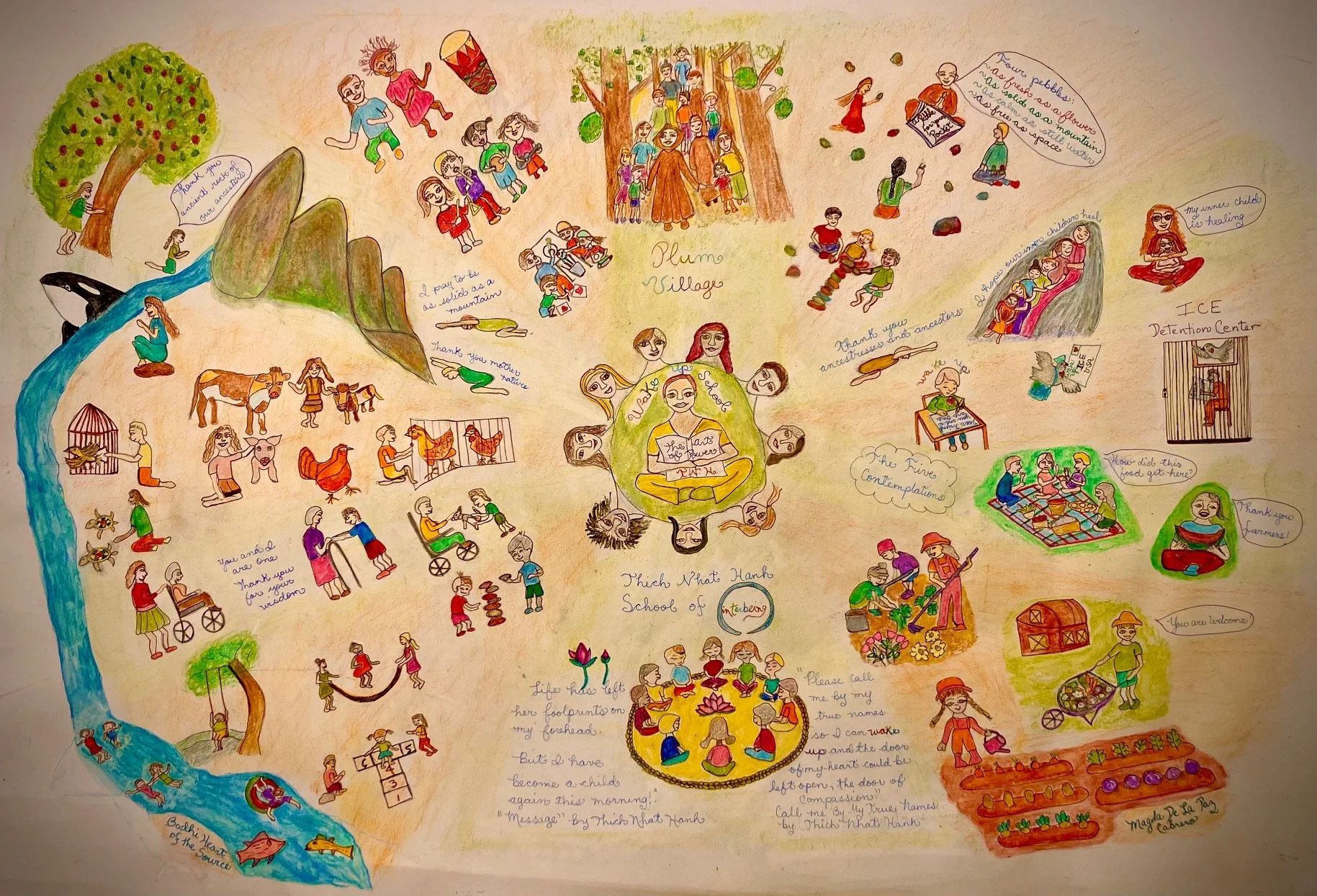
Illustration by Magda Cabrero
“The soul is healed by being with children.”
-Fyodor Dostoyevsky
“Every child begins the world again.”
-Henry David Thoreau
At a recent art exhibition I participated in at Cedar Lane Unitarian Universalist Congregation, I noticed a little girl speaking with Mary Smith from our sangha as they stood before my illustration, The Gifts for Little Girls. The piece is intricate, filled with many elements—including twelve girls—yet the child’s attention rested on a single small figure: a girl sitting quietly beneath Bodhisattva Quan Âm, meditating and receiving a dove from Avalokiteshvara. The moment quietly filled me with hope. I found myself imagining future generations receiving an education rooted in interbeing and the Wake Up spirit—children growing up in mindfulness and deep awareness.
At the same time, I feel concern as I watch this country become more divided, often led by those who treat power as a means of accumulation rather than a way to care for people or the Earth. And yet, there are hopeful signs—recent polls suggest many young people feel uneasy with the country’s present state. In contrast to places like Nazi-era Germany, when large majorities of youth were absorbed into and outwardly supportive of the regime, it seems there is growing resistance to the division, fear, and hatred in our own society.
I often wonder what kind of world we will leave to our children and whether we are capable of loosening our attachment to ego—of learning to live in interbeing with all things, as Thầy invites us to do. In such moments, I return to the work of Elinor Ostrom. In Governing the Commons, she challenges the idea that shared resources are doomed to be squandered, suggesting instead that failure often stems from conditions that make cooperation difficult. Where boundaries are unclear, accountability is weak, and participation is limited, trust can erode; yet where communities cultivate clarity, fairness, and shared responsibility, the commons can endure. Her work offers a gentle counterpoint to theories that predict inevitable failure, reminding us that communication, trust, and creativity can open other possibilities for collective life.
In that light, I find some hope in efforts that nurture these capacities. I am inspired by the group Cultivating a Culture of Interbeing and the development of the Project of Interbeing, as well as Harvard University’s Project Zero, whose Good Project and Visible Thinking frameworks encourage perspective-taking, ethical awareness, and a sense of interconnection. Deer Park Monastery in California is also establishing a Thích Nhất Hạnh School of Interbeing (K–8), where mindfulness, community life, and ecological awareness are woven together with academic learning. Closer to home, I feel grateful for the energy of Wake Up DC, who now meet in our Opening Heart Mindfulness Community space—their presence, sincerity, and engagement, including projects like writing letters to immigrants in detention, carry forward Thầy’s legacy in meaningful ways.
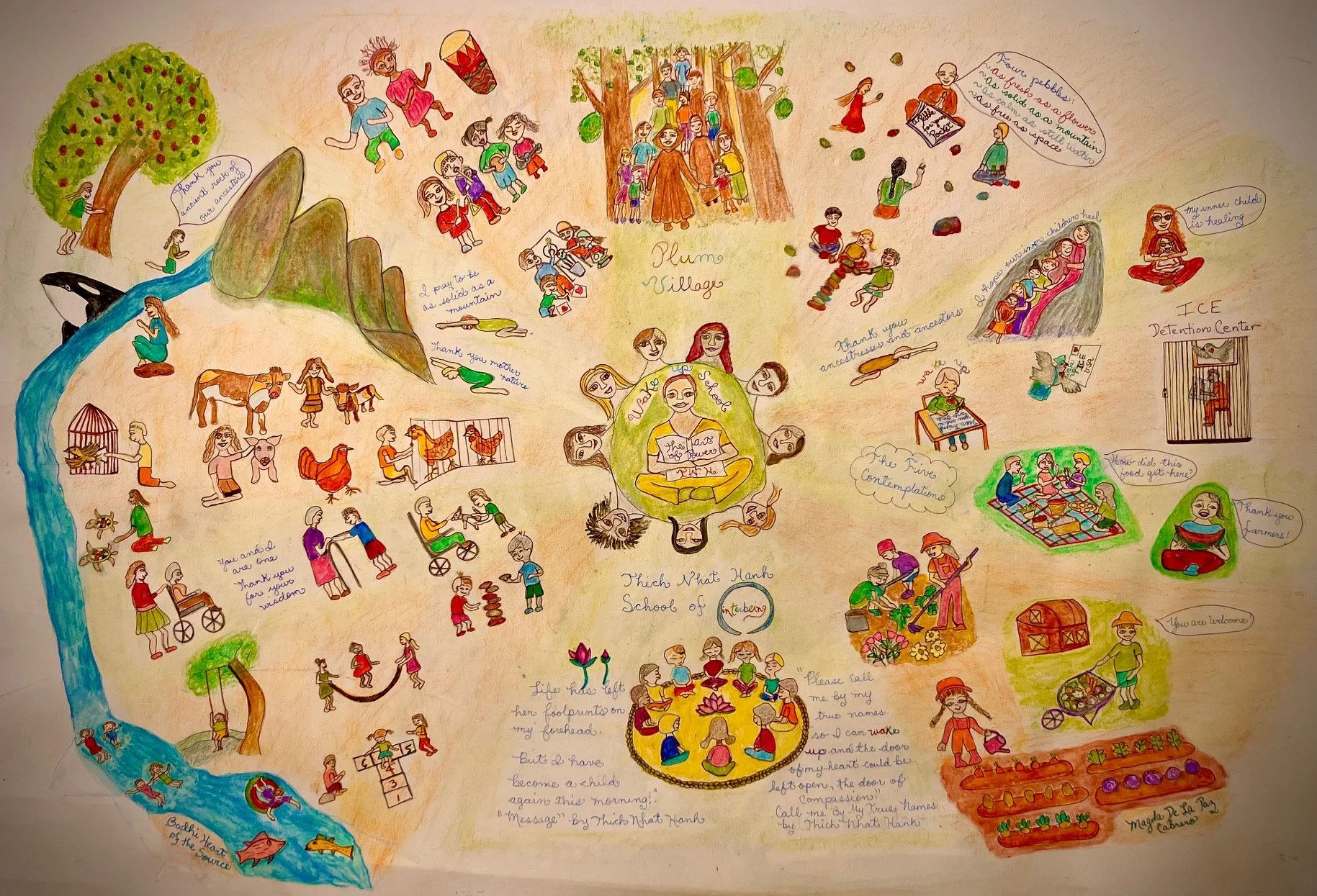
In my illustration, I tried to capture some of these possibilities: children doing walking meditation with Thầy; communities gathered in mindfulness; young people connected to nature, to one another, and to those most in need. I imagine them practicing gratitude, deep listening, and compassionate action—approaching power not as domination, but as the art of caring for the world.
I do have concerns about the effects of social media and artificial intelligence on future generations. Yet when I think of that young girl, quietly absorbed in the image of a child meditating, I feel a quiet sense of hope. I can begin to imagine schools shaped less by punishment and more by understanding—places that turn first to mindfulness and dialogue, and that help nurture what Thầy might call true “Earth holders”: serene, compassionate human beings, learning the art of using power to protect and sustain life.