
Monday, January 19, we will meet online.
Dear friends,
This week, we will meet Monday evening, January 19, from 7-8:30PM ET online; Wednesday morning, January 21, from 7-8AM ET in person at our meditation space (3812 Northampton Street NW); Thursday morning, January 23, from 7-8AM ET online; and Friday, January 9, 12-1PM ET online.
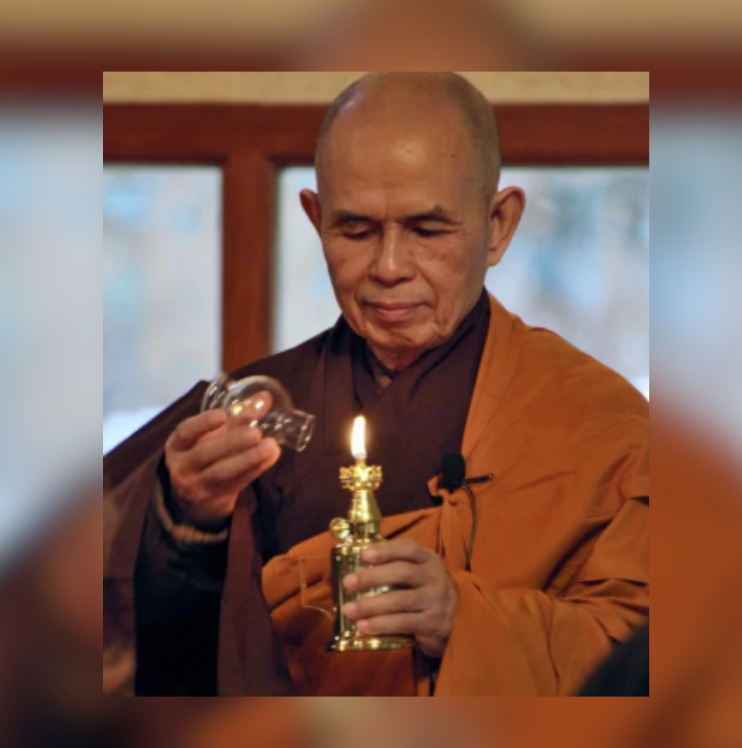
As we approach the three year anniversary of Thich Nhat Hanh’s (Thay’s) transition, we invite you to join us for an evening of reflection and gratitude.
On Monday night, we will enjoy sitting and walking meditation, and then listen to a talk by Thay about selective seed watering, a practical way to nourish our consciousness. (A brief description is below.) Then, we will enjoy sharing the ways that Thay’s presence, teachings, and/or practices have influenced our lives.
In the coming days, we invite you to reflect on these questions:
How have Thay’s teachings nourished you?
What practices do you turn to in times of need?
Are there other aspects about Thay or his teachings that have had an impact on you?
If you scroll down, you’ll find our responses to some of these questions.
Also, if you would like to bring a remembrance to share, such as a poem, song, or quote, you are most welcome.
We look forward to practicing together.
Camille & Marie
—---------------------------------------------------------------------
A description of selective seed watering from Thay’s book, Touching Peace:
“According to Buddhist psychology, our consciousness is divided into two parts, like a house with two floors. On the ground floor there is a living room, and we call this “mind consciousness.” Below the ground level, there is a basement, and we call this “store consciousness.” In the store consciousness, everything we have ever done, experienced, or perceived is stored in the form of a seed, or a film. Our basement is an archive of every imaginable kind of film stored on a videocassette. Upstairs in the living room, we sit in a chair and watch these films as they are brought up from the basement.
“Certain movies, such as Anger, Fear, or Despair, seem to have the ability to come up from the basement all by themselves. They open the door to the living room and pop themselves into our videocassette player whether we choose them or not. When that happens, we feel stuck, and we have no choice but to watch them. Fortunately, each film has a limited length, and when it is over, it returns to the basement. But each time it is viewed by us, it establishes a better position on the archive shelf, and we know it will return soon. Sometimes, a stimulus from outside, like someone saying something that hurts our feelings, triggers the showing of a film on our TV screen. We spend so much of our time watching these films, and many of them are destroying us. Learning how to stop them is important for our well-being.
“Traditional texts describe consciousness as a field, a plot of land where every kind of seed can be planted—seeds of suffering, happiness, joy, sorrow, fear, anger, and hope. Store consciousness is also described as a storehouse filled with all our seeds. When a seed manifests in our mind consciousness, it always returns to the storehouse stronger. The quality of our life depends on the quality of the seeds in our store consciousness.
“We may be in the habit of manifesting seeds of anger, sorrow, and fear in our mind consciousness; seeds of joy, happiness, and peace may not sprout up much. To practice mindfulness means to recognize each seed as it comes up from the storehouse and to practice watering the most wholesome seeds whenever possible, to help them grow stronger. During each moment that we are aware of something peaceful and beautiful, we water seeds of peace and beauty in us, and beautiful flowers bloom in our consciousness. The length of time we water a seed determines the strength of that seed. For example, if we stand in front of a tree, breathe consciously, and enjoy it for five minutes, seeds of happiness will be watered in us for five minutes, and those seeds will grow stronger. During the same five minutes, other seeds, like fear and pain, will not be watered. We have to practice this way every day. Any seed that manifests in our mind consciousness always returns to our store consciousness stronger. If we water our wholesome seeds carefully, we can trust that our store consciousness will do the work of healing.”
----------------
Marie shares: Selective seed watering is one of my favorite teachings and practices–not that I’m attached! It is comforting to remember that I have every imaginable seed in my basement (store consciousness), and that everyone does. Knowing that how I tend this inner garden will influence what grows feels empowering. I love the visual of the seeds in my basement (store consciousness) being watered, plumping up, and then sprouting up into my living room (mind consciousness).
As I reflected on this topic, I was struck by how my inner garden has changed over the years and the impact this has had on my life, and sometimes, when I am unskillful, strong emotions can still take over. I remember our young son (who also found this imagery helpful) calling out with alarm, “Mummy, those vines have come up and grown all over my living room. It’s a jungle!” This memory makes me smile, watering a wholesome seed, and I feel such warmth and gratitude for our dear teacher.
----------------
Camille shares: One teaching that has left a lasting impact on me is loving speech and deep listening, and with that, the art of communicating. While this teaching originates from the precepts of the Buddha many years ago, Thay has made it more relevant and accessible to us in our daily lives with the Five Mindfulness Trainings. He has shared that by first connecting with ourselves and our suffering, we will be able to connect more deeply with others. When we can communicate with ourselves, we will be more available to communicate with others. Because of Thay’s teachings, I have learned that to listen with compassion is not just about listening to the words but about listening with the intention of lessening the suffering of the other person and helping them empty their heart. When we speak lovingly and mindfully, our communication can only get better.
Compassionate communication, or even just communication, over the years with some family members has sometimes been a thorn in my side. In my mind I am listening, sometimes for hours, and find that the desire to interrupt or correct is my go-to habit. Not a good habit energy. My intention can start out good, but then I hear what I think are wrong perceptions, I feel I am being blamed, or there is bitterness in the conversation, and that is when I lose my capacity to listen or I interrupt. That is the time when the debate can start. Thay taught that before that debate happens is when I need to practice mindfulness of compassion. That’s the time when I need to come back to my body and practice mindful breathing. As I practice more and more in this way with those people who I find challenging, I am able to have more space to listen to others and help them suffer less.
I will continue to hear Thay’s gentle voice in my mind. When he speaks he exudes peace, compassion, and wisdom. I am forever grateful for his loving and caring words.