Monday, July 6, we will meet online.
New to sangha?
This Monday we are offering an optional Newcomers Orientation.
Learn more and sign up here
Dear Friends,
This week, we will meet Monday evening, July 6, from 7-8:30PM ET online; Wednesday morning, July 8, from 7-8AM ET in person at our meditation space (3812 Northampton Street NW); and Friday, July 10, 12-1PM ET online.
On Monday, our evening meditation will be facilitated by Magda. We will continue our Monday evening summer reading of Thich Nhat Hanh’s At Home in the World. Our discussion will focus on the second chapter, Life in Vietnam, with special emphasis on the story of the Hermit and the Well, summarized below. Read on for Magda’s reflections on this story.
In The Hermit and the Well, Thầy recalls searching for a hermit in the mountains as a child. Unable to find him, he instead discovered a beautiful natural well where he rested and fell asleep. Though the hermit was absent, the solitude and intimacy with nature allowed him to experience the hermit’s presence in another form. When friends later asked about the journey, he chose silence.
In the Sea of Words, I Dwell in My Inner Island.
Today, with phones constantly demanding our attention, there is an expectation that we answer immediately. Yet, as I walk beside the ocean in silence, listening to the rhythm of the waves and my breath, I let the phone ring unanswered until I finally place it on silent mode.
At the end of my walking meditation, I think of others immersed in their own nourishing rituals—prayer, gardening, rest, exercise. Would they abandon those moments simply because a phone rings?
Sometimes people ask, “Why didn’t you answer?” Perhaps one day I will reply:
I was dwelling in silence. Rooting myself. Allowing the energy of my mind to settle deeply before returning again. This silence is essential to my creativity, spiritual life, and ability to meet you again with presence.
Silence has become essential to me. Every morning, I become a hermit.
As someone deeply engaged with the world, I feel the need each day to return inward. Like Thầy in the section Hermitage in the Wind—from the upcoming chapter, “Blossoming of Plum Village”—closing the windows of his hut to protect its stillness, I try to preserve an inner space that remains untouched by the constant noise of the world.
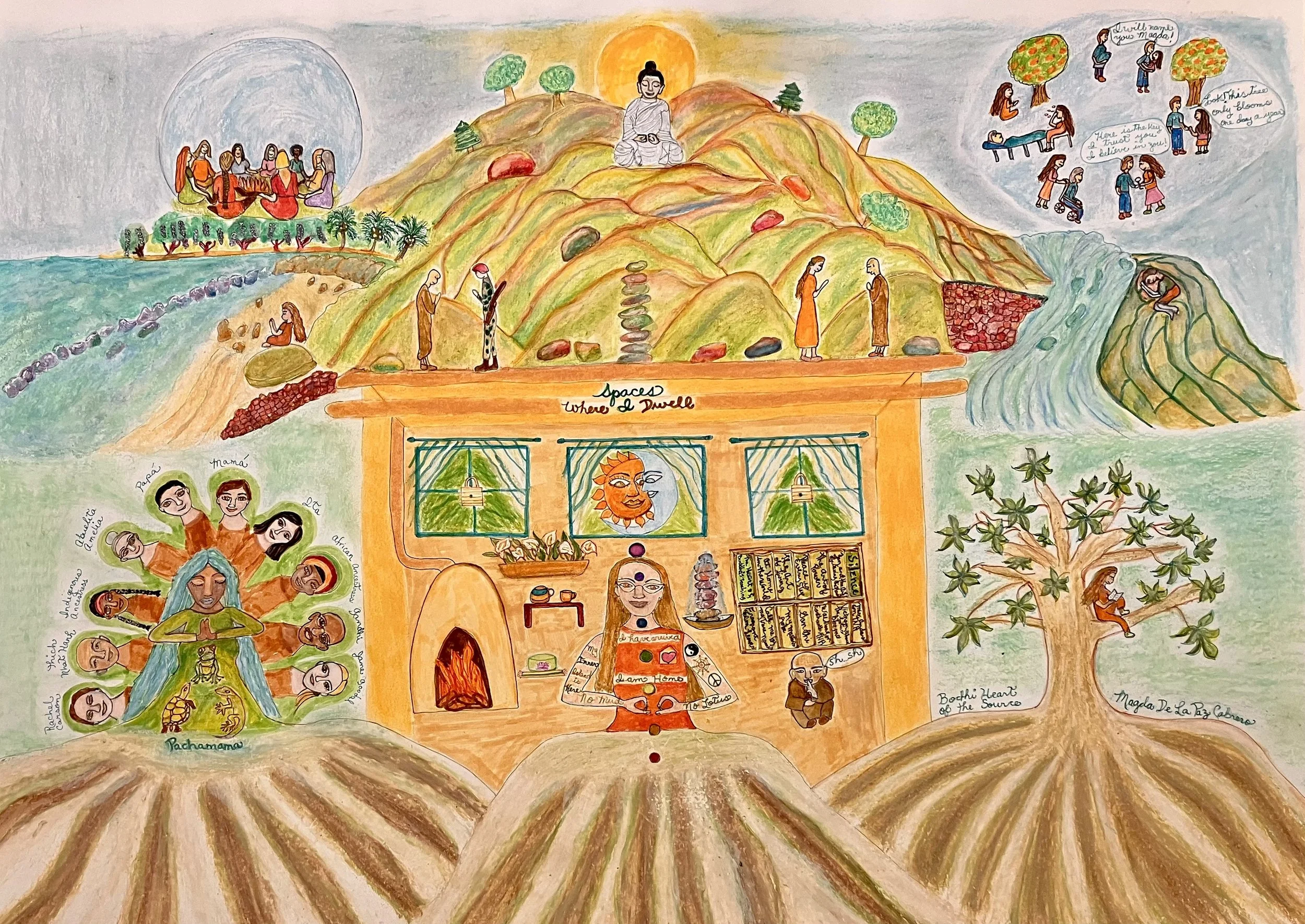
In my illustration, the hermit’s hut becomes my New Mexico-inspired adobe casita. Some windows are locked to protect silence, yet I remain open to the sun and moon. In that space, mind and body—nāma-rūpa—become one. Grounded deeply in the earth, I feel calmer, steadier, and more alive.
Within this inner dwelling, I cultivate self-love and compassion. I examine my mental formations, asking whether they nourish understanding or strengthen separation. I sit honestly with suffering, transforming inherited pain and caring for the wounded child still within me.
This practice is sustained by warmth, by water, by plants and books and silence. Solitude dissolves duality and reveals interbeing more clearly. It becomes the space where I learn to balance caring for others with caring for myself.
I reflect on my ancestors, my children, and the many pilgrims I have encountered across the world. Though we appear separate on the surface, we belong to the same river of life.
Sometimes I simply sit with suffering gently, allowing healing to emerge so I may return to the world carrying less harm and more compassion.
And yet, when people ask what I was doing, I simply say, “I was meditating.” A word that may mean little to some, but that to me, means everything.
Some may mistake this solitude for selfishness, but it is what allows me to engage with the world with less judgment, less reactivity, and greater acceptance—accepting the mud that gives birth to the lotus.
Before I speak again, before I offer words in service of peace and compassion, I must first protect the boundaries of sacred silence.
On Monday evening we might share:
our experience of silence,
where we are able to find our own experiences of the hermit’s hut,
other reflections on this chapter,
and anything else on our hearts.