Monday, October 19, we will meet in person.
Go to calendar for our schedule
Address for OHMC meditation space:
3812 Northampton St. NW, Washington DC 20015
Please arrive a few minutes early so we can invite the bell on time. You may also arrive 15 minutes early to practice working meditation by helping us set up cushions.
Dear friends,
This week, we will meet Monday evening, October 19, from 7-8:30PM ET in person at our meditation space (3812 Northampton Street NW); Wednesday morning, October 21, from 7-8AM ET online; and Friday, October 23, 12-1PM ET online/in person (Hybrid).
On Monday, our evening meditation will be facilitated by Magda.
“For several days we sat together on Vulture Peak until sunset, and I realized that in former times the Buddha had looked at the same setting sun with the same eyes. After-wards, we walked down the mountain slowly and mindfully, not saying a word, and since that day, I have continued to walk in the same way.” The Heart of Buddha’s Teaching
As I take my daily walk along the beach when I visit Puerto Rico to accompany my elderly mother, I breathe in rhythm with my feet kissing the warm, wet sand and with the waves rolling onto the shore. I think of my mother, who was recently taken to the hospital because of breathing difficulties. I remember someone at Plum Village, or perhaps at the European Institute of Applied Buddhism, speaking about breathing as if each breath might be our last.
My mother has recently begun walking again after a fall, thanks in large part to Luis, whom I see as a miracle worker. Watching her now is like watching a young child take her first steps. She looks constantly for support.
“Magda, come here when I do this,” she says.
She seeks encouragement and rewards after her hard work, almost as if I were now her mother.
“I will take you out for ice cream after your therapy,” I tell her.
Luis encourages her to focus on every step. “Always start with the heel, then let your toes touch the ground.”
I notice that at times her breathing becomes rapid. After one of her remarkable efforts, he gently reminds her, “Breathe!”
I think of Thich Nhat Hanh and mention him to Luis, hoping he might add another dimension to the daily miracle he already inspires with so much love, tenderness, and mindfulness.
“¿Conoces a Thich Nhat Hanh?” (“Do you know Thich Nhat Hanh?”) I ask.
“Creo que he oído de él,” (“I think I have heard of him,”) he replies.
I tell him how Thich Nhat Hanh invited us to kiss the Earth with every step.
Luis is fascinated by my ninety-three-year-old mother.
“Tu mamá es excepcional,” he says. “Creo que solo uno de cada cien camina a su edad después de una caída.” (“Your mother is exceptional. I think only one in a hundred can still walk at her age after a fall.”)
I cannot think of a better way to express my gratitude for how he has inspired my mother to believe she can walk again than to give him a Spanish copy of my book, Walking on Earth with Thich Nhat Hanh.
I think of Sister Annabel, the first Western nun ordained by Thich Nhat Hanh. In her book True Virtue: The Journey of an English Buddhist Nun, she writes of how, long before discovering the Plum Village tradition, she was already in India practicing with Tibetan nuns. Yet she had not discovered Thầy’s simple invitation to walk mindfully, synchronizing each step with each breath and bringing full awareness to the miracle of walking.
“My first teacher (not Thay) had done his best to encourage me to walk slowly, but just to walk slowly was not enough. Walking meditation also has to contain peace, joy, and presence” (p. 66).
“The river moves, but not in search of anything, unless it is chasing clouds. The river stops chasing clouds when it sees that clouds are itself. The water that makes the river is also the water that makes the clouds. I wanted to move and be still as I moved. Later I would have the insight that with walking meditation this is altogether possible” (p. 67).
I think again of my mother.
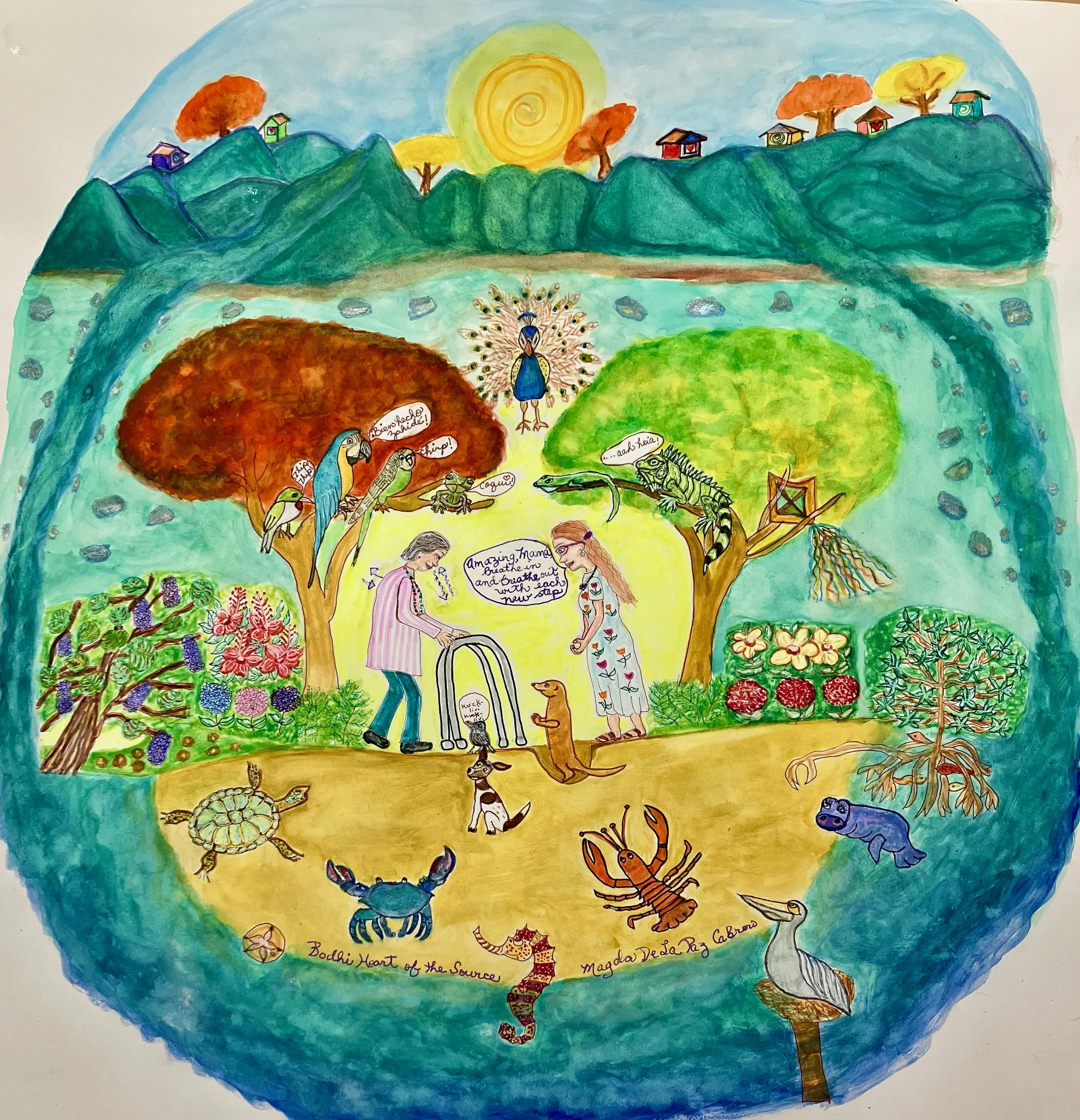
After therapy, I take her for an ice cream. Supported by her walker, she walks slowly to the rental car. I want to normalize her life, to take her out into the world, to remind her that she can still walk trium-phantly into life and that she still belongs fully to it.
I tell her to concentrate on her breathing.
“Mamá, take each step with a breath. Be happy and grateful that you are alive, that you are still capable of walking and breathing. Walk as if you have already arrived. As if you are home.”
As she walks, I watch her feet carefully meet the ground, heel first, then toes, each step a small miracle. I think of Thầy's invitation to kiss the Earth with every step. Earlier that morning, my own feet had kissed the warm, wet sand as the waves rolled onto the shore. Now, my mother's feet kiss the ground with the same tenderness, each step accompanied by a breath, each breath a quiet affirmation of life.
And as we move together, kissing the Earth step by step, breath by breath, I realize that perhaps we have both arrived. We are home—not because we have reached a destination, but because, in this mo-ment, we are fully present TOGETHER on this beautiful Earth.